For years, hermetic Radio Frequency (RF) packaging was viewed as a necessary enclosure, a way to protect sensitive electronics from moisture, contaminants, and harsh operating environments.
Today, that perspective is rapidly changing
As defense, aerospace, and commercial space systems push toward higher frequencies, greater power densities, and increasingly compact architectures, the package itself has become an integral part of system performance.
Increasingly, the success of an RF design depends not only on the electronics inside the package, but on the package itself.
RF Systems Are Evolving
Modern RF systems are dramatically different than those designed just a decade ago.
Engineers are now developing systems that demand:
- Higher operating frequencies
- Greater bandwidth
- Increased power density
- Lower weight
- Smaller form factors
- Improved thermal management
- Greater environmental durability
Whether designing phased-array radar, satellite communications, electronic warfare systems, or advanced sensors, engineers are under constant pressure to improve Size, Weight, Power, and Cost (SWaP-C) without sacrificing performance.
That challenge extends directly to the package.
A Package Is More Than a Box
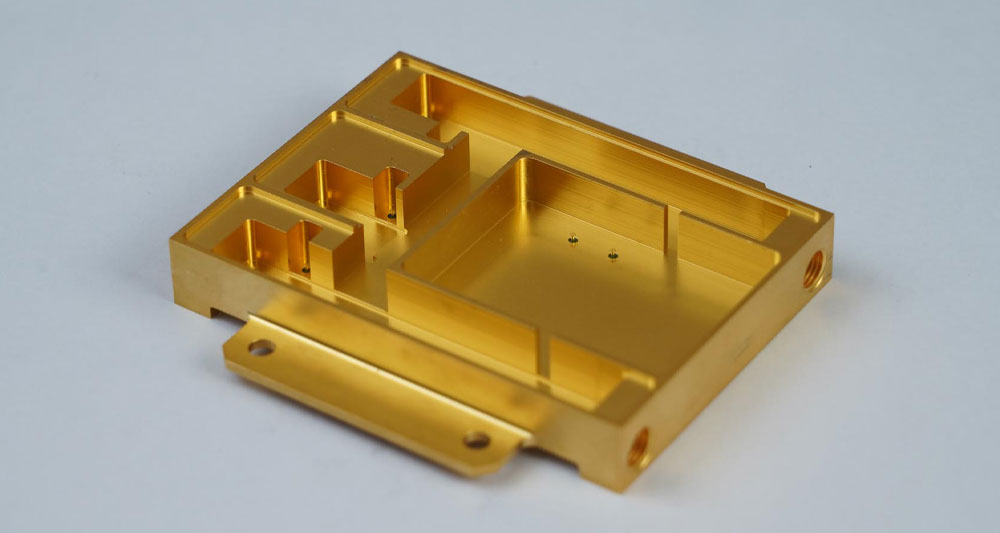
The traditional view of a hermetic package is simple: keep contaminants out and protect the electronics.
While hermeticity remains essential, today’s packages must accomplish much more.
They frequently serve as:
- Precision mechanical structures
- Thermal management components
- RF performance features
- Structural elements
- Alignment references
- Interfaces to the larger system
Every design decision, from wall thickness to cavity geometry, can influence thermal behavior, manufacturability, and even RF performance.
As operating frequencies continue to increase, seemingly minor mechanical details can have significant electrical consequences.
Design Freedom Matters
Many RF package designs are still constrained by manufacturing limitations rather than engineering requirements.
Sharp internal corners, inaccessible features, multiple-piece assemblies, and simplified cavity geometries are often the result of machining constraints—not optimal design.
5-axis machining changes that equation.
Complex internal features, deep pockets, compound angles, and intricate cavity geometries can be produced with far fewer manufacturing compromises.
This gives engineers greater freedom to optimize designs for system performance rather than ease of manufacture.
Precision Is a Performance Requirement

At microwave and millimeter-wave frequencies, precision is no longer simply a manufacturing metric, it is a performance requirement.
Small dimensional variations can affect:
- Component alignment
- RF interfaces
- Thermal contact
- Manufacturing repeatability
- Long-term reliability
Consistent machining processes and tight dimensional control help ensure that every package performs as intended, particularly in mission-critical aerospace and defense applications.
Thermal Management Starts with the Package
Power densities continue to increase across RF systems.
Whether supporting high-power amplifiers, transmit/receive modules, or other active components, packages play a critical role in moving heat away from sensitive electronics.
Effective thermal management requires careful consideration of:
- Material selection
- Package geometry
- Mounting interfaces
- Thermal paths
- Manufacturing precision
The package is no longer simply protecting the electronics, it is actively enabling their performance.
Why Manufacturing Capability Matters

As package geometries become more sophisticated, manufacturing expertise becomes increasingly important.
The ability to machine complex hermetic packages in-house using 5-axis machining provides several advantages:
- Greater geometric flexibility
- Reduced secondary operations
- Improved dimensional consistency
- Faster design iteration
- Simplified supply chains
- High-quality surface finishes for demanding sealing and assembly requirements
For engineers developing next-generation RF systems, these capabilities translate into shorter development cycles and greater confidence during production.
Building Packages for the Next Generation of RF Systems
The demands placed on RF packaging will only continue to increase.
Higher frequencies, greater power densities, more compact architectures, and increasingly challenging operating environments are redefining what engineers expect from their packaging solutions.
At CPS Technologies, we believe hermetic packages should do more than simply protect sensitive electronics.
They should enable better thermal management, support precision manufacturing, simplify assembly, and allow engineers to fully optimize system performance.
Because in today’s RF systems, the package is no longer just a housing.
It is a critical part of the design.
Global Innovation at CPS Technologies
Ready to discuss your hermetic packaging design needs?
CPS offers a suite of innovative solutions to give clients complete peace of mind in their solution. With our state-of-the-art AlSiC composite, proprietary machining processes, and time-tested expertise, we’ll show you why CPS is a trusted partner in the industry.